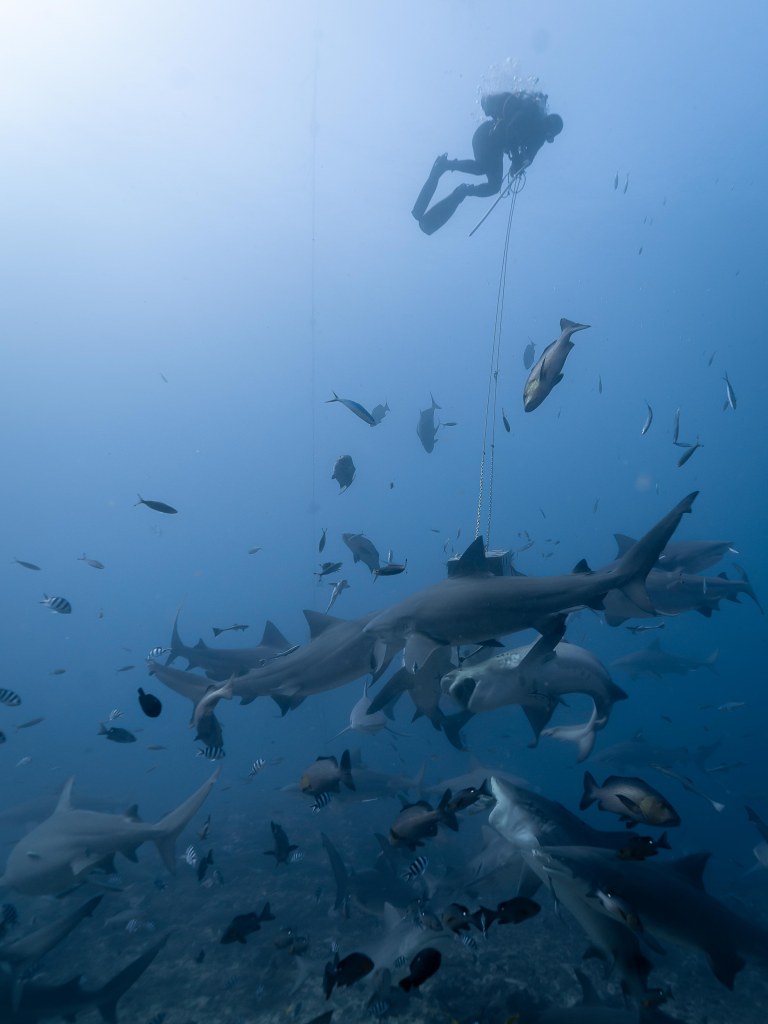

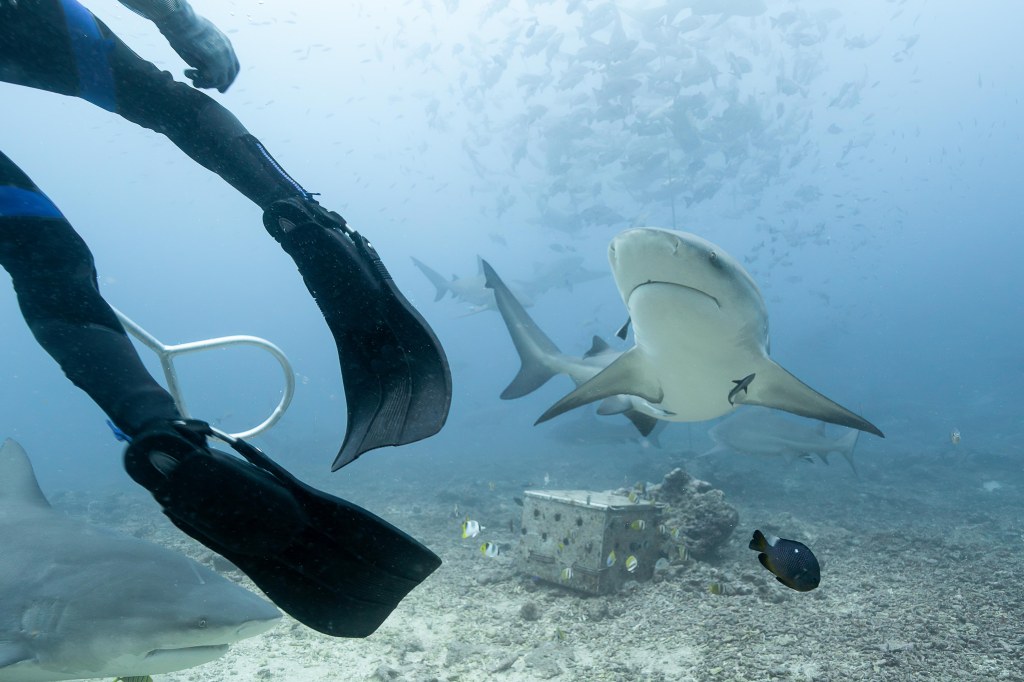
The Beqa Bull Shark Dive is a baited, cage-free scuba dive at 30m at the bottom of a reef. Divers descend on a line and park themselves at the edge of an amphitheatre rock wall, with dive masters as guards standing behind them. A tuna-scented bin is suspended and the attracted sharks swim around it while the divers watch. Some of the more curious bulls come close to the divers but the dive masters use a curved aluminum pole to encourage them to move along.
My first dive, I thought I was going to vomit I was so nervous. The dive master briefed us on everything from our safety stops to instructions for aborting the dive to what to do if there is suddenly a tsunami warning. To be clear, there have been injuries – mostly for the dive masters – but in 20 years, I could find only one reported case of a non-fatal injury of a tourist. So I was going on statistics that if I followed all the instructions in the safety briefing, I’d probably be safe.
Baited shark dives are controversial. On one hand, attracting apex predators to an area where people fish and play raises the concern that sharks will associate people with food. Also, the shark population could change their behaviour in a negative way, interrupting their diversity of diet, migration and mating. The benefits could be that money can be made to establish and maintain marine parks from tourist fees, and tourists swimming with sharks can convince the general population that sharks need to be preserved for the health of the oceans.
At Shark Reef in Fiji, a locally-managed marine park was established in 2014. In Fiji, communities own their reef and fishing management is governed by the community. The tourist dive operators approached several communities with a plan to establish a ‘no-take’ zone for tourism, with each tourist paying a marine park fee to the communities. Ten years later, the marine park fee generates $100 000 USD a year for the communities to use for municipal government spending, and fishing outside the marine park has improved because the park acts as a nursery for the reef fish.
As for the bull sharks–some theories as to whether the baited shark dive has a negative effect, or even neutral effect on the bull shark population have been studied. Fijian bull sharks are ID’d on the reef and appear to leave for mating and migration, and tissue samples show that their diet remains diverse. Also, there are no increased reports of shark bites of people as the bull sharks seem to associate tuna with smell and electro-action of the flurry of small fish around the tuna head (so if you’re swimming without tuna heads in your pocket, you’re unlikely to attract a bull shark). What isn’t yet researched is whether the bull shark population stays healthy when they’re clustered together for a few hours 5 days a week, given they are normally solitary predators. And finally, the argument whether exposing tourists to baited shark dives makes the general population more sympathetic to the preservation of sharks is debatable–dive tourists showing up to hang out with bull sharks – the most aggressive shark of any shark species – is already a group of folks who are shark-crazy.
And to be honest, none of the arguments against baited shark dives dissuaded me from signing us up for four days of diving. My motivation was to take pictures of one of the most amazing animals on the planet.
Bear with me for a mini-history and political diversion
400 million years ago, before the continents slid into their current formation, there were just two major continents and one big ocean. Plants started to develop seeds, vertebrate fish first developed jaws, and the first sharks appeared. Four mass extinctions later…and sharks survived. It makes them older than trees and the Pacific Ocean.
However, in the last 50 years, there’s been a drop in 70% of the shark population due to fishing: shark-specific or sharks killed in by-catch. To protect them, and by association, the health of the ocean, we have to establish massive marine parks that would cover 30% of the oceans by 2030 (we’re currently at <1%) and establish a more robust regulated fisheries to limit takes and eradicate by-catch. In 2023, the UN passed the High Seas Treaty and given the urgency to save the planet, ideally it needs to be signed and ratified by 60 countries by June 2025 so it will become international law – check here if your country has signed and ratified the treaty – and if not, lobby your federal representative. It is an amazing treaty, 20 years in the making, and only 9 countries so far have ratified it (Let’s go Canada! Ratify it already!).
One of the top 10 dives in his life
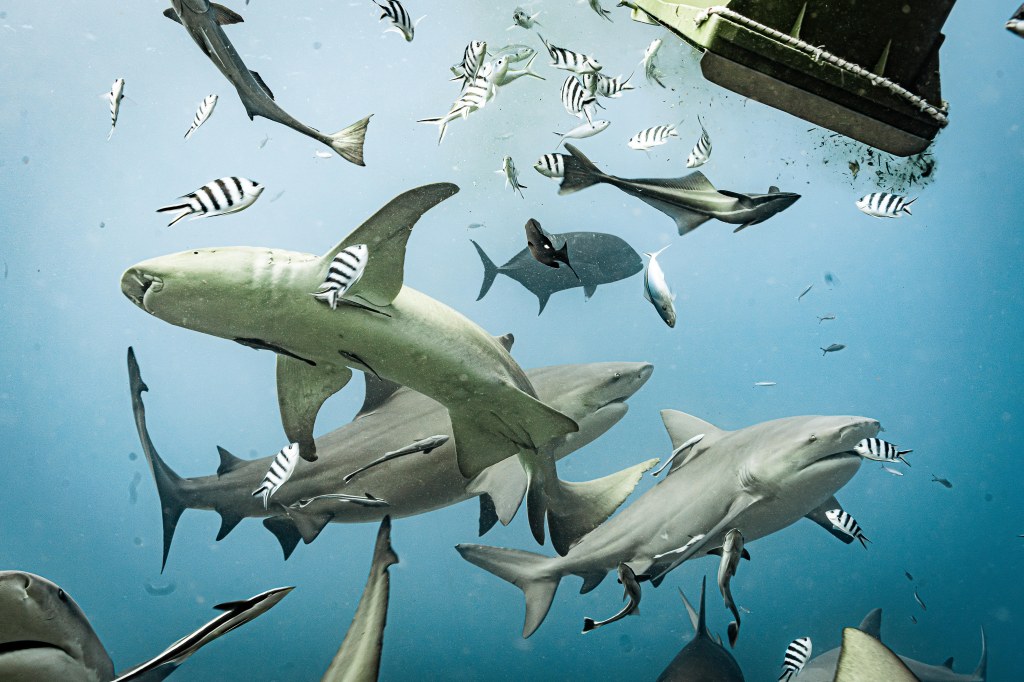
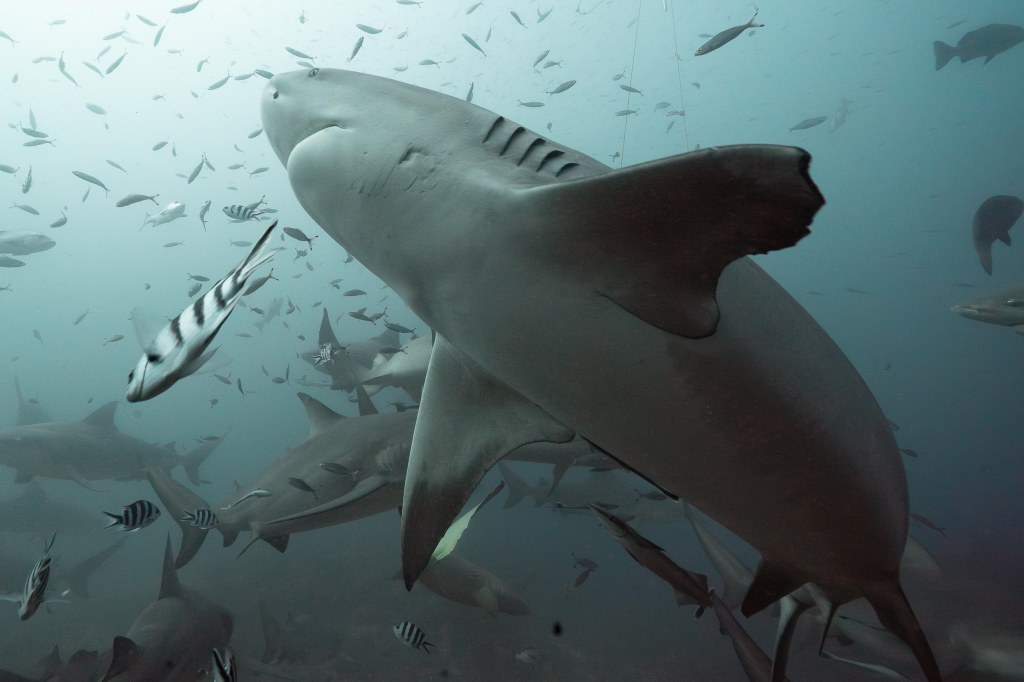
To be sure, Ian doesn’t keep track of his accomplishments. He lives in the moment and keeps moving forward onto new adventures–so he doesn’t know how many dives he’s done, maybe 500? But he ranks dropping into the amphitheatre to watch six species of sharks as one of the the top 10 dives in his life. We watched lumbering bulls, graceful tawny nurse sharks, excitable black and white tip reef sharks, kinda bull-wanna-be lemon sharks and many greys that have no sense of personal space. They’d swim around us, sometimes bumping into us mainly because we were in the way. All were completely disinterested that we were there except the bulls who would occasionally wander by, making eye contact with their reflection in my dome lens of my camera.
I have to say, I’m cool with baited shark dives, and I think telling people that I loved the shark dive and would encourage anyone comfortable with scuba to do it–hopefully encourages everyone to have some compassion to save sharks (if you’re still queasy about sharks, start with an easy one like the Puffadder Shy Shark who curls up into a ball and brings its tail over its eyes when threatened).
We’re now onto Vanuatu, a cluster of islands west of Fiji and north-east of Australia. Made up of 83 islands (and we hope to visit 5), has 138 languages, and produces 20 times less carbon emissions per capita than their Canadian counterpart…stay tuned


 Sailing Afrikii
Leave a comment