
Here are some boat specs from the point-of-view of Ann, a beginner.
In order of Maslow’s heirarchy of needs – we’ll cover the foundation of basic shelter and safety first
SHELTER
Provenance: Mouvaux France
Make model year: Wauquiez Amphitrite 1984
Length: 43′ or 13.1m
Hull: Fibreglass (maybe 1 inch of fibreglass between me and the ocean I hear churning past my head when I sleep)
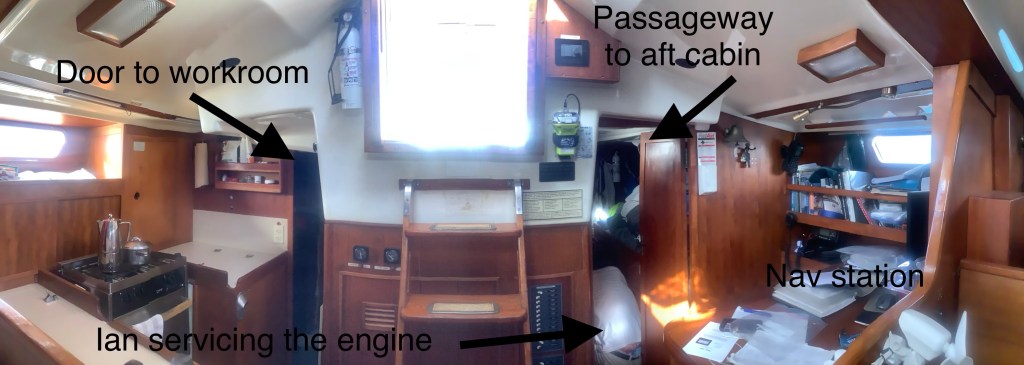
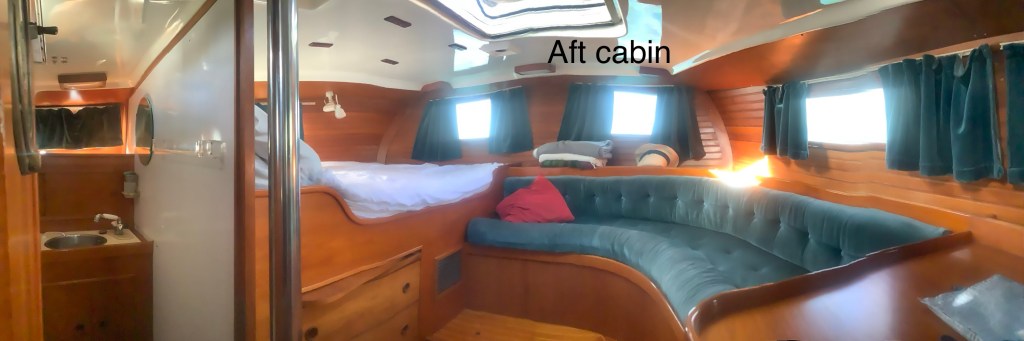
Two bedrooms (aka aft cabin and v-berth) and two bathrooms with showers (aka aft and forward head).
Four 200L water tanks – can be filled in a marina or we can use the onboard watermaker to make 60L/h powered by the boat batteries.
Electricity comes from a bank of four Li batteries – they are charged by 3 solar panels or by running the engine (i.e. burning diesel fuel). Ideally, it’s most efficient to run everything on DC power (charging off the batteries of the boat) and not needing to go through the inverter to AC power (regular wall plugs).
The kitchen (galley) has a little DC powered fridge, two little sinks with freshwater tap, and the stove has two propane burners and an oven slightly bigger than my friend’s Easy-Bake oven in childhood.
Toilets – they work, that’s all I really know. 2 saltwater flush (one hand pump and one electric).
SAFETY
The safety list is endless, and built-in redundancies are because offshore, redundancy equals backup. This is what I’ve learned so far:
Life jackets – Ian put me in charge of researching life jackets. After a deep dive into youtube reviews, we ended up with self-inflating Team-O 170N since I was convinced that should one of us go overboard, the rear-tow and hoist innovation was essential
Life raft – 6-person Viking offshore
Ditch bag – this is a pre-packed bag of supplies to take with you in the life raft—think of Life of Pi.
Anchor – we have two – I hadn’t given anchors much thought before but I now appreciate a good heavy anchor with a good strong chain so you don’t anchor in the evening in a pretty bay and end up in a busy shipping lane by morning
Emergency steering – mercifully, this is a thing. If your steering cables break, you twist off this nub of black plastic on the deck and drop a heavy steel bar into the hole, pass it through the bench in the aft cabin and lock it onto the rudder and voilà, you have emergency steering
Bilge pump – if water comes into the boat, a little detector turns on a motor and pumps it out. There’s also a manual bilge pump on deck near the wheel so you can steer and pump should you take on water in bad weather
Fire prevention – lots of awareness and extinguishers are everywhere. Turn off the propane after every use God help me, this is how I’m going to end it for both of us I’m afraid
Knife rules – my set of very sharp Japanese knives are secured in a cupboard. I take one out, use it, clean and put it back in the case. We have a no-loose-Japanese-knife rule at anchor…and a no-Japanese-knife rule while underway
Man-or-woman-overboard (MOB) – uhh, we’ll get this organized better but we have had some simulations of me dropping things and Ian retrieving them while at anchor (he’s got 2 for 3 – to be fair, the third item, he wasn’t even present). The chart plotter at the wheel has a ‘mark’ button if someone goes overboard you can mark the spot while underway, somehow hoping to come back to that spot to find them. And we have a MOB pole you throw overboard that floats with a flag, so you can see the location of the person when the waves are high. Our life jackets also have a personal AIS device.
Medical kit – this is something that I feel comfortable with although it is unlikely we will have an emergency birth on board. I recommend Marine Medicine by Weiss for instructions such as managing ciguatera poisoning, carbon monoxide hazards, or the chapter on fish hook and speargun injuries
Higher levels of need
Shelter and safety are pretty much a constant focus. We’ve taken small forays up Maslow’s hierarchy of need, addressing belonging, creativity and accomplishment. This is operationalized one DC powered freezer to make ice cubes for cocktails, one dinghy with outboard, assortment of dive gear, two spearguns (Ian’s), four different cameras (mine), one Bose portable speaker, one guitar, and stacks of books.
Once we’ve covered these needs, we can move up to Maslow’s highest level – that nirvana-like self-actualization that comes with the excitement of leaping into the unpredictable, the satisfaction of some semblance of testing your grit and self-sufficiency, and gaining the new skills that you know will rock during a zombie apocalypse.




 Sailing Afrikii