
I remember coming home from grade school and finding that the National Geographic had arrived in the mail. This National Geographic issue was different. Between the pages of photos and text, it contained a flexible vinyl record.
We had a small record collection, one album was Nana Mouskouri and another was ABBA’s Greatest Hits, which I bought with my first babysitting money. But this National Geographic record was not of a band or a musician, but of a recording of whales.
“Whales sing,” my dad confirmed. When my dad was a merchant marine in South America in the late-1940s, he shuttled oil from Venezuela to Curacao’s refinery. He’d hear them through the hull of the ship.
I spent the weekend sprawled out on our gold shag carpet, reading the article on the songs of the humpback whale and listening to the vinyl over and over. It was haunting, beautiful, slow and mournful.

We humans share a common ancestor with whales that goes back 60 million years. Cetaceans, the whale taxonomy class, started out on land and moved to live in water full time; whereas we humans started out in the water and moved onto land, maintaining our mammalian dive reflex. Where whales and humans crossed paths as they entered the water and we exited, there may have been an exchange of communication – with the humpback whale specifically. Humans and humpbacks are the only animals, as far as we know, to come up with new sequences of songs over our lifetime.
But maybe more interesting is the non-novel sequences of humpback whale songs that appear today. Just as I can recognize a K-pop cover of ABBA’s Super Trouper, with its English-Korean difference compared to the original English-Swedish version, there are contemporary recordings of humpback whale songs in Hawaii that are the same sequence of sounds from the 1970s recording that was made in Puerto Rico and distributed by National Geographic.
Let that sink in for a minute.
Humpback whales share songs over space (the Australian tribe seems to be the greatest hits makers) and time (decade-long gaps and then songs are resurrected like beloved vinyl we find in the attic). Just like ABBA hits, songs are shared by tribes of humpbacks across oceans and handed down to generations, resurrected as an oral tradition of a culture. This theory blew my mind – whales have culture.
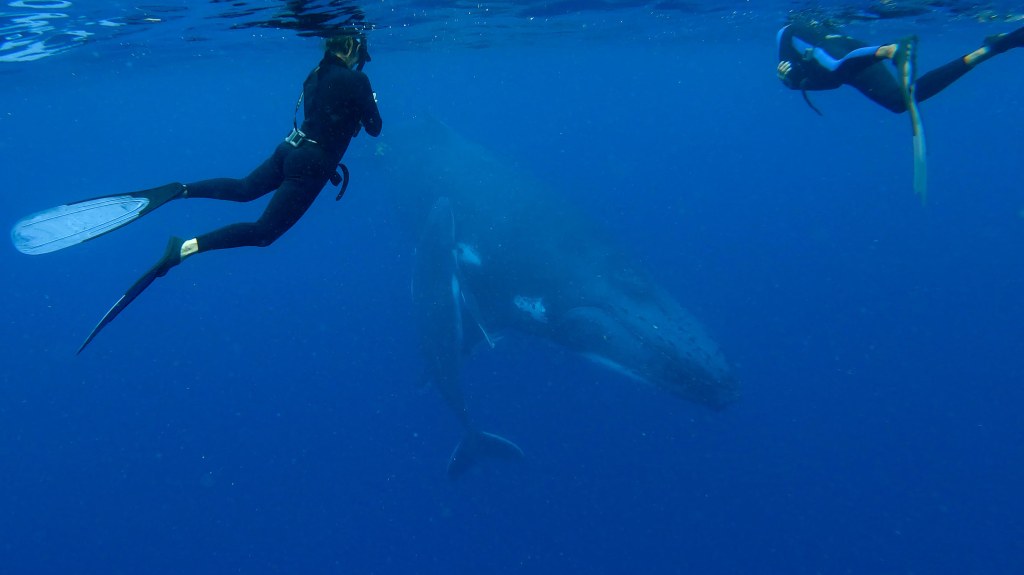
In the northern group of islands of Vava’u in the Kingdom of Tonga, humpback whales migrate up from Antarctica to calve and mate. Antarctica has an abundance of food in the Southern hemisphere’s summer but the winter is spent in Tonga where it’s warm but there is relatively little food. A humpback cow will give birth and nurse for 5 months, losing a quarter of her body weight before arriving back in Antarctica with a strong, fat calf.
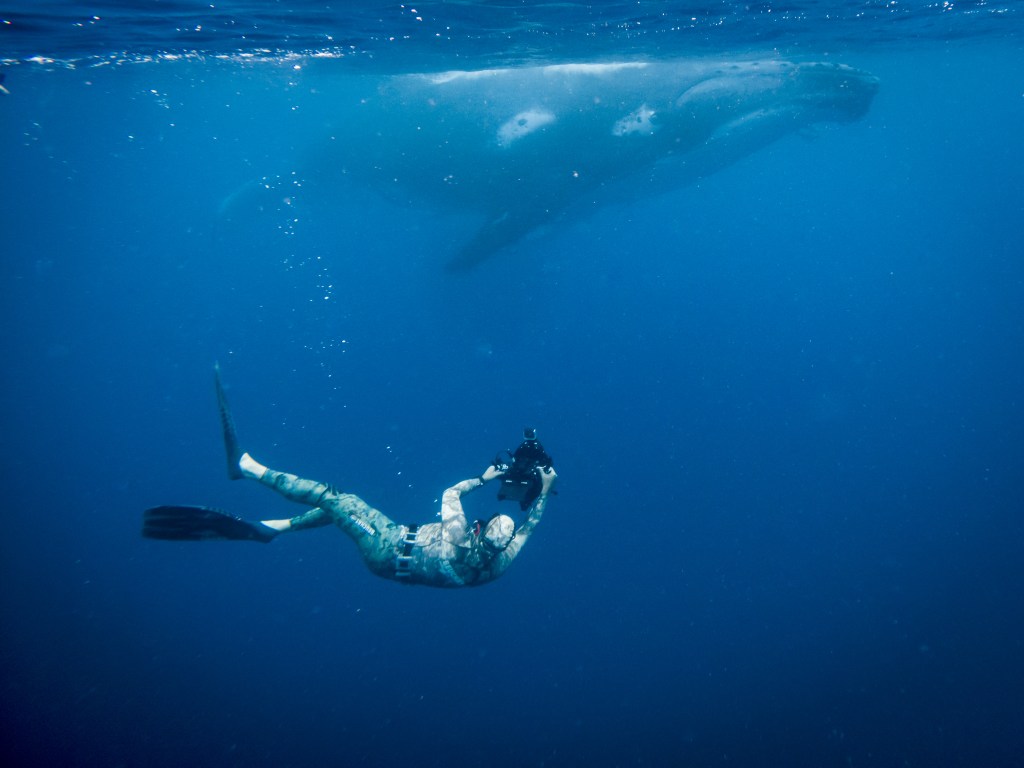
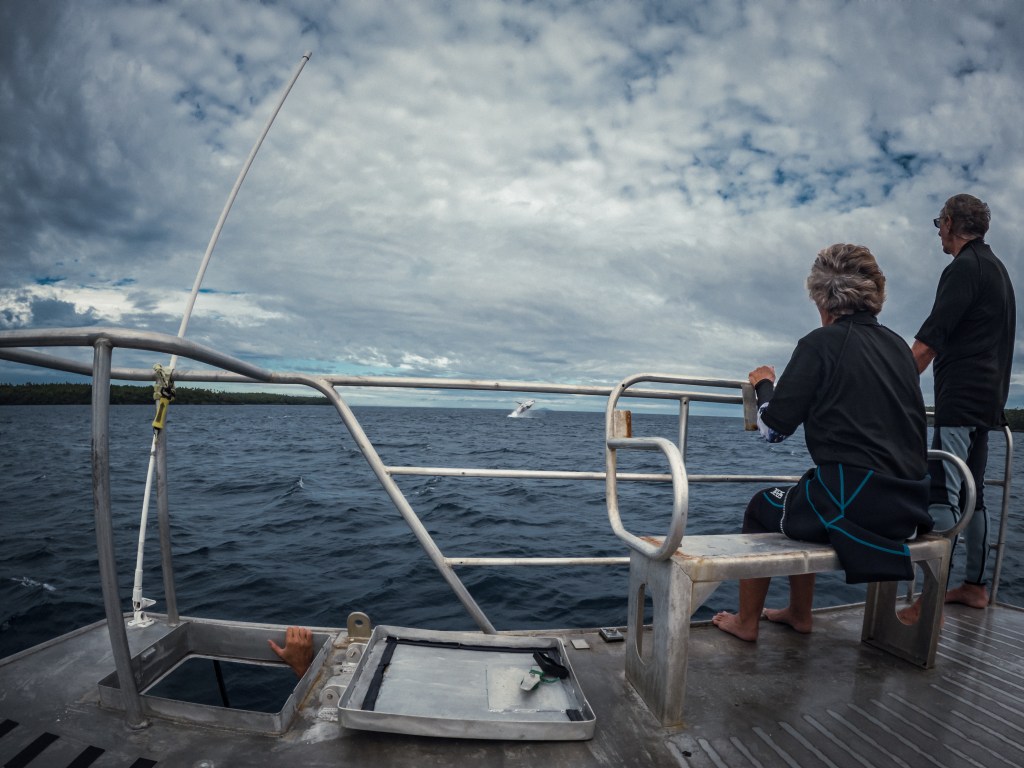
Being in the water with a cow and calf takes some mettle. The seas are choppy, the water colder than I’d like. Slipping off the back of the whale tour boat and paddling in their direction is like being introduced to a graceful giant in an immersive children’s book – you completely suspend any belief that you’re able to anticipate what comes next. I’m in her world, she has a baby, she is not a bear, I think to myself.
I want her to see me at all times so she doesn’t inadvertently drown me somehow. But she knows exactly where I am relative to her calf because she has exquisite directional hearing. She’s silent and resting. The calf is about a month old and has mastered his buoyancy enough that he can drop down below her to nurse, and direct himself upwards to breathe. After a while, he takes a tour beyond his mother and tracks past me and Ian, curious but confident that his mom is right behind him. She seems to communicate with him somehow and moves past me, re-establishing a safe distance between us and her calf.
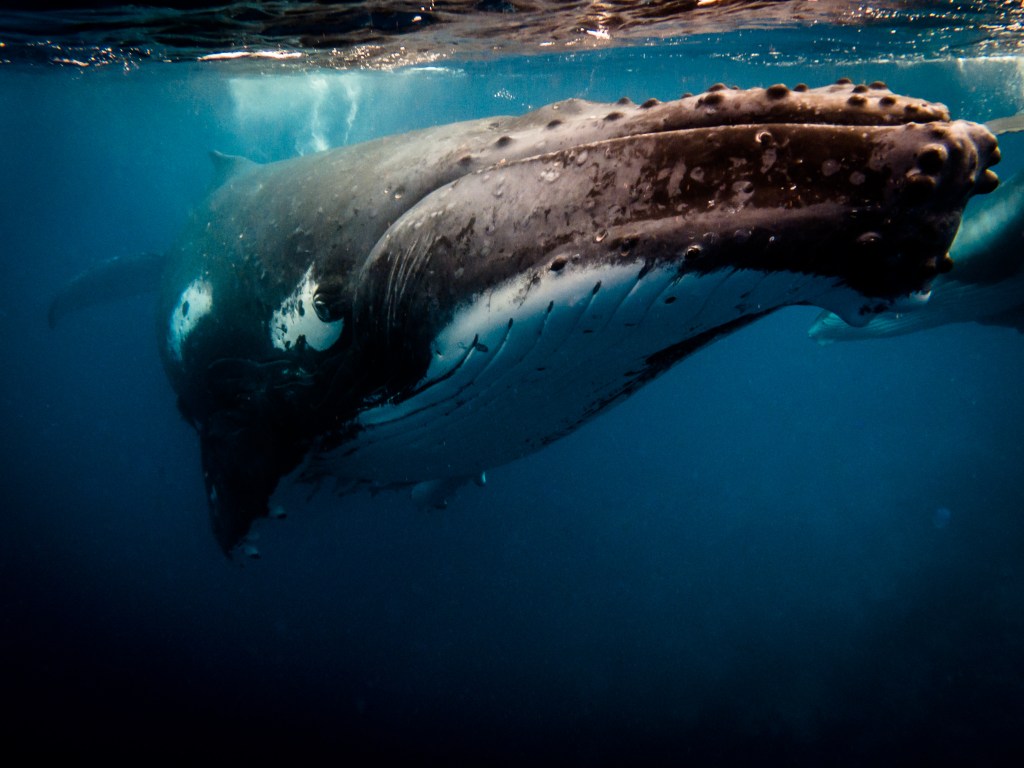
Beautiful footage of all of this and swimming with competing males singing was captured by Mike Bhana, videographer for Netflix, and should appear in an upcoming episode of Saving Oceania. I’ll keep you posted.


 Sailing Afrikii
Leave a reply to Ian Redwood Cancel reply